Choosing the right patch style will depend largely on how durable your design is in the garment. From soft chenille through waterproof PVC, different substrates call for different manufacturing procedures. No matter which material you select, structural quality starts with a clean digitizing stitch file. For expert artwork conversion, trust Capital Digitizing to deliver crisp details and optimized machine outputs for all your custom embroidery patch projects.
Why Patch Type Matters
Various patch designs impact more than just aesthetics. Substrate and thread combinations will determine clarity of detail, texture, weight of garment, unit price, and durability.
Before placing an order for custom embroidered patches, consider the target clothing and application conditions:
- Workwear & Uniforms: Need high thread counts and sealed borders due to regular industrial washing.
- Tactical Gear & Backpacks: Require waterproof materials such as PVC or flexible real leather.
- Sports & Varsity Apparel: Thick and plush texture is required, like chenille yarn with thick felt backing.
It doesn’t matter what physical fabric you choose; structural quality always begins with the digitized stitch file.
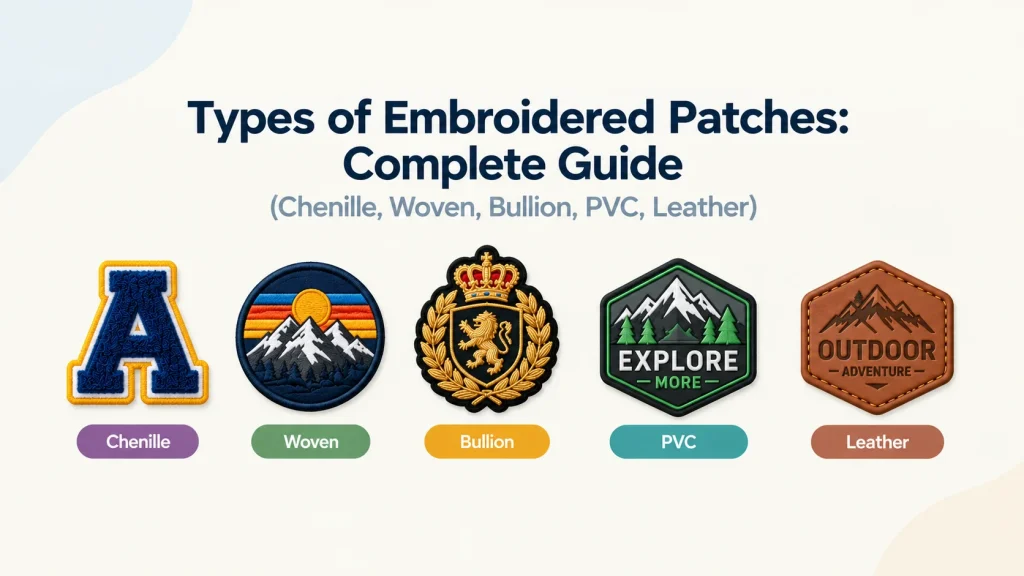
Quick Comparison: 6 Patch Types at a Glance
Before discussing each of the materials in detail, let’s compare them in one chart. The choice between quality woven patches and conventional thread materials mostly depends on artwork complexity and application.
| Patch Type | Base / Material | Detail Level | Texture | Typical Border | Best For |
| Embroidered | Twill fabric + thread | Medium | Raised | Merrowed border or heat-cut | Uniforms, jackets, team logos |
| Woven | Fine thread woven on loom | Very high | Flat, smooth | Merrowed or heat-cut | Small text, intricate logos |
| Chenille | Looped yarn on felt | Low | Plush, fuzzy | Often none | Varsity and letterman jackets |
| Bullion | Gold or silver wire | Medium | Metallic, 3D | Usually none | Blazers, military, crests |
| PVC | Rubber / PVC | High (moulded) | Rubbery, 3D | Moulded edge | Tactical, outdoor, bags |
| Leather | Leather or faux leather | Low–medium | Debossed or stitched | Stitched | Jeans, caps, bags |
Note: Always check the minimum size needed and the prices for production with your supplier before you place large orders.
Embroidered Patches (Twill Fabric)
Classic custom embroidered patches feature thread sewn onto a strong fabric base. The diagonal pattern in twill fabric allows for many stitches without causing the fabric underneath to bunch up.
- Key Features: Bumpy surface, very strong, can be set up in different ways.
- Backings: Iron-on, sew-on, Velcro, or sticky.
Pros:
- Provides a traditional, valuable raised surface.
- Very strong and long-lasting even after being washed many times in industrial machines.
- Affordable for medium to large orders.
Cons:
- Struggles with text smaller than 4mm high.
- Cannot capture complex color gradients.
- Can feel heavy on thin fabrics.
Verdict: The best option for work clothes and team logos.
Woven Patches
When logos have small letters or close lines, woven patches work best. Instead of sewing on fabric, thin threads are intertwined on a loom to make a flat, smooth surface. Find out more in our guide on embroidered vs. woven patches.
Pros:
- Easily picks up small letters and intricate pictures.
- The very thin design lies flat on light clothing.
- The smooth surface doesn’t get caught on things.
Cons:
- Doesn’t have a 3D raised design.
- Doesn’t really have an old-fashioned appearance.
Verdict: Works better where appearance is more critical than feel.
Chenille Patches
Chenille patches are made using thick yarn that is wrapped around felt to make them fuzzy like those on letterman jackets. Yarn loops are too thick to show small writing or fine details clearly.
Pros:
- Gives a soft, fluffy, and thick feel.
- Gives a traditional school team style.
Cons:
- Not good for small writing or thin lines.
- Needs to be washed carefully.
Verdict: Best for school, club, and athletic jackets.
Bullion Patches
For top-quality emblems, bullion patches provide the best quality. If you are wondering what a bullion patch is, these expensive symbols are made of gold or silver wire coils that are sewn on felt.
Pros:
- Delivers a shiny, three-dimensional look.
- Great for special events and formal occasions.
Cons:
- More expensive and takes longer to make.
- Cannot be machine washed.
Verdict: Best for blazers, military honors, and premium crests.
PVC Patches
Composed of soft and flexible material, patches made of PVC are waterproof, UV-resistant, and very durable. With a 3D design, PVC patches will stand up well to outdoor conditions.
Pros:
- 100% water-resistant and easy to clean.
- Retains crisp 3D images without fading.
Cons:
- Stiffer than traditional fabric patches.
- Lacks the feel of traditional threadwork.
Verdict: Ideal for tactical equipment, outdoor equipment, and bags.
Leather Patches
Leather patches give an appearance of simplicity to casual garments and headgear. They are made from leather or synthetic leather and can be embossed, laser-cut, or patched with custom patches.
Pros:
- Provides a classic look that stands the test of time.
- Durable on heavyweight materials such as denim and canvas.
Cons:
- Limited to basic designs and color combinations.
- Needs washing with caution to prevent drying out.
Verdict: Ideal for a trendy casual look with jeans, caps, and bags.
Border Types: Merrowed vs Heat-Cut
Merrow border is a strong overlocking thread border used to seal the patch edge and prevent it from fraying. The border is best for round, oval, or geometric patches for uniforms. Heat or laser borders are used for irregularly shaped patches with sharp edges and corners where the overlock border cannot be used.
| Border Type | Visual Look | Best Application |
| Merrowed Border | Thick, rounded thread ring | Symmetrical emblems, work uniforms |
| Heat-Cut / Laser | Flat, clean sealed edge | Custom die-cut shapes, sharp angles |
Best Patch Type for Jackets, Caps and Uniforms
Selection of the correct style is based on the weight of the garment material, placement area, and complexity of the design. Design complexity will demand custom embroidery digitizing for the design before machine production.
- Jackets: Heavier jacket materials will hold heavier chenille patches on the back or metallic bullion crests on the chest pocket area.
- Caps: Structured hats will demand lightweight woven materials or leather patches that will flow nicely with the curved crown panels without buckling.
- Uniforms: Heavy-duty workwear demands classic custom patch embroidery with a merrowed border to withstand repeat washing.
Decision Tip: Make sure the weight of the patch matches that of the weight of the clothing fabric you wish to put it on. Heavy patches rip through light shirts, while light patches don’t suit heavy outerwear.
How to Choose a Reliable Patch Maker
Choosing a professional manufacturer means that your final products will be produced according to the artwork proof and will be delivered on time.
Selection Checklist
- Physical Proofs: Make sure the supplier provides digital samples and stitchouts before actual production.
- Digitizing Quality: Confirm that the factory makes use of high-end digitizing processes to avoid issues with inconsistent thread tension, missing stitches, or broken threads.
- Transparent Terms: Seek companies that provide detailed information on minimum order quantities (MOQ), lead times, and pricing tier breakdowns.
- Verified Industry Reputation: Get help from professionals like Capital Digitizing, which is the best embroidery digitizing company providing special digitizing services to patch makers and clothing companies in the USA.
While looking for customized embroidery digitizing services in the USA, getting assistance from an experienced embroidery patch maker gives you the best and high-quality vector designs to use with the machine.
Key Takeaways
Choosing the best type of patch involves the complexity of the design, weight of the fabric, and the ability of the fabric to cope with various types of weather. Proper choice of materials, including conventional thread, fine line threads, chenille, and tough PVC, among others, will guarantee that the bright logo endures for a long time and adds value to the clothes.
Get flawless patch digitizing with Capital Digitizing, delivering precise vector conversions and production-ready machine files every time.
FAQs
1. What are the main types of custom patches available?
Different varieties exist, which include embroidered, woven, chenille, bullion, PVC, and leather patches. All these use different base fabrics and manufacturing methods for different types of clothing.
2. What is the difference between embroidered, woven, and bullion patches?
Embroidery patches have raised designs made by using thick threads on twill material. Woven patches are made with the help of thin threads. Bullion patches use wire to make three-dimensional metal crests.
3. What is a merrowed border and when should I choose it?
A merrowed border is a strong overlocked thread border that goes around the edge. Use it for conventional symmetrical patches in uniforms to avoid any edge fraying.
4. What is the average minimum order quantity for custom patches?
Minimum order quantities are different with various suppliers, ranging from 10 to 50 units per run, depending on the type of patch being used.
5. Which patch type works best for jackets, caps, and uniforms?
Plush chenille or bullion patches are best for heavy jackets. Woven or leather patches are preferable for caps because of their curved crowns. Uniforms should be made with embroidered patches.
6. How do I select a reliable custom patch manufacturer?
Choose a supplier that is experienced and offers samples before production, quality stitch digitization, clear pricing levels, various materials, and satisfied customers.