Businesses are often confused about which types of patches to use. There are tons of articles telling them to use embroidered, while others tell them to use woven, each giving out their own reasons. This embroidered patches vs woven patches blog tells you exactly what to do and what suits your purpose.
How is Each Patch Actually Made?
The difference between embroidered and woven patches is in the manufacturing.
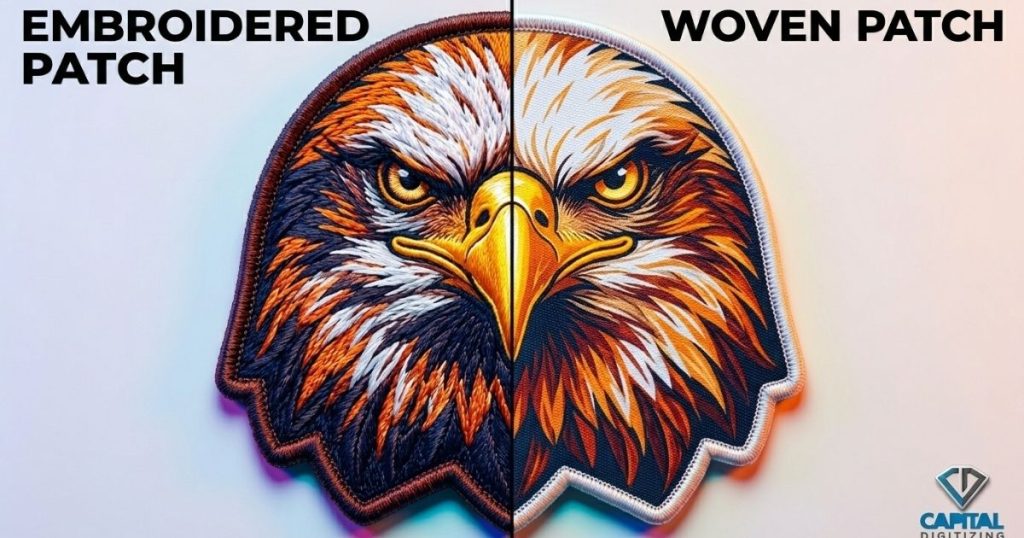
Embroidered patches are stitched. Thick thread, commonly #40 weight, is sewn on top of a base fabric, usually cotton twill, and supported underneath by a stabiliser. The thread sits above the fabric, which is what creates the raised, tactile surface.
Woven patches are woven. Ultra-fine thread is interlaced on a loom, and the threads form the patch itself rather than sitting on a separate backing. There is no base fabric showing through because the weave is the material. The surface finishes flat and smooth.
That distinction cascades into everything: detail capability, thickness, flexibility, cost logic and the way each type behaves in a wash.
Our breakdown of materials used in custom embroidered patches covers the twill, thread and stabiliser side in more depth.
Measurement Decides It
Open your artwork. Find the smallest piece of text and the thinnest line. Measure them at the finished patch size.
Embroidery’s floor sits at roughly 3mm text height, about 8 to 9 point. Below that, individual stitches begin to merge, and letters stop being letters. Some manufacturers put the safe threshold higher, at a quarter inch for block capitals, and treat anything under that as compromised legibility. Thin lines under about 2mm are similarly unreliable.
This is not a quality issue. It is thread thickness. Embroidery thread has to be thick, because it needs to build a raised surface and survive the machine without breaking. That thickness sets a hard floor on how small detail can go.
Woven handles text at roughly half that size, because the thread is finer and the weave packs far more thread per inch. Lowercase and script lettering usually stays legible. Woven patches can be produced at sizes as small as about 30mm overall.
The most common ordering mistake in this category is choosing embroidered for a logo with small text and receiving something blurry. The second most common is choosing woven while expecting a raised, three-dimensional look, then finding the result resembles a clothing label. Both are preventable by measuring first and requesting a mockup before production.
Woven Patches vs Embroidered Comparison Table
Below is a list of differences which can help you to decide the best type of custom patch you require.
| Embroidered patches | Woven patches | |
|---|---|---|
| Construction | Thick thread stitched onto twill base | Fine thread woven on a loom; thread is the fabric |
| Thread weight | Typically #40 | Ultra-fine |
| Surface | Raised, textured, dimensional | Flat, smooth, close to a printed look |
| Thickness | Thicker, more body | Thin, low profile |
| Minimum text | Around 3mm (8–9 pt) | Roughly half that |
| Thin lines | Around 2mm minimum | Handles finer |
| Colour blending | Layered threads create gradient effects | Shade concentration simulates gradients |
| Base fabric | Cotton twill plus stabiliser | None required |
| Flexibility | Stiffer | More flexible, works inside or outside a garment |
| Best on | Denim, canvas, heavy twill, jackets | Caps, activewear, delicate fabrics, small items |
| Minimum patch size | Larger | Down to roughly 30mm |
| Aesthetic | Traditional, rugged, military, varsity | Modern, high-resolution, corporate |
What Each Type Really Costs
The general answer is that woven costs less. The accurate answer is that it depends on stitch coverage, and this is where most comparison articles stop too early.
Woven pricing is relatively flat. The loom runs the same way regardless of how complex the artwork is. Detail is nearly free.
Embroidered pricing scales with coverage. More thread means more machine time. A patch with 90% or more stitch coverage, where almost no backing twill shows, needs considerably more thread and time than one with moderate coverage.
Conclusion
Embroidered patches and woven threads are different in construction. Choose embroidered for abrasive or outdoor conditions and woven for regular apparel. Choose Capital Digitizing as it is one of the best embroidery digitizing companies. Just send us the design and finished size.
FAQs
What is the main difference between embroidered and woven patches?
The main difference is the construction. Durable custom patches that are embroidered have thick thread, typically #40 weight. Stitched on top of a cotton twill base with a stabiliser underneath, producing a raised, textured surface. Woven patches interlace ultra-fine thread on a loom so the thread forms the patch itself. There is no separate backing fabric, producing a flat, smooth finish. That single manufacturing difference drives every other distinction in detail capability, thickness, flexibility, and cost.
Which type of patch is more durable?
Embroidered patches are generally more durable because thicker thread is stitched into a twill base. It gives the patch more body and an anchoring layer. Woven patches use thinner thread without that base, so they are somewhat less resistant to heavy wear.
Are woven patches cheaper than embroidered patches?
Usually, but not always. Woven pricing stays relatively flat regardless of design complexity, since the loom runs the same way, whatever the artwork. Embroidered pricing scales with stitch coverage. A patch with 90% or more coverage costs noticeably more than a woven equivalent.
Which patch type is better for small text or detailed logos?
Woven is better. Embroidery has a practical floor of about 3mm text height are unreliable because thread thickness sets the limit. Woven patches hold text at roughly half that size and keep lower-case and script lettering legible. For custom patches for businesses, woven can be the best.
Can I choose embroidered for some areas and woven for others in the same patch?
Yes, mixed-format patches are available from many manufacturers. A common combination is a woven centre finished with an embroidered or merrowed border, which gives crisp fine detail alongside a bold raised edge. The reverse also works: raised embroidery for logo shapes with woven sections handling small text. Availability differs by supplier, so confirm before designing around it.
Which patch type is best for corporate uniforms vs sports teams?
Corporate uniforms usually suit woven patches, because business logos carry small text, precise typefaces, and exact brand colours. Sports teams usually suit embroidered patches, since team crests are bold and graphic.