
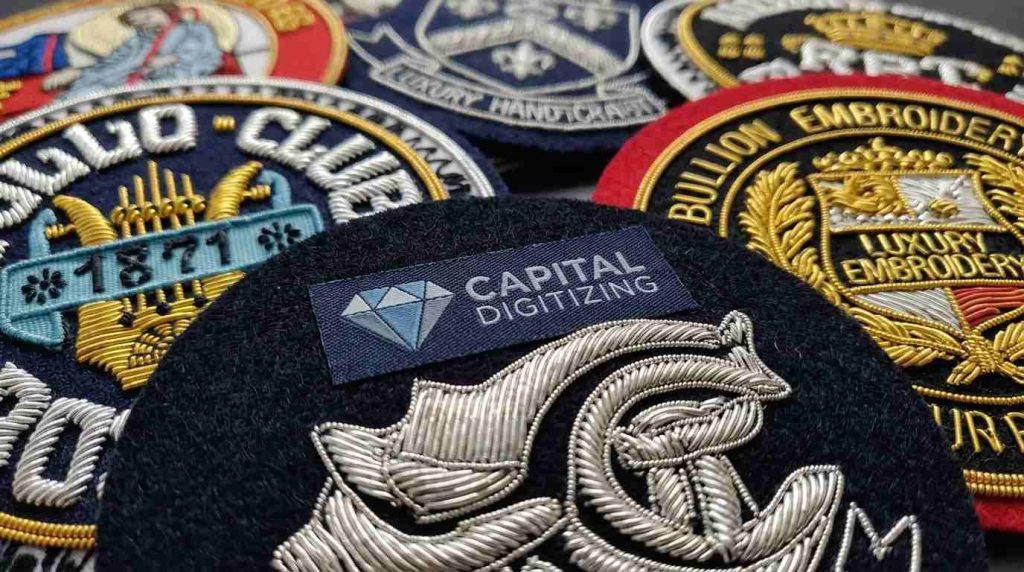
A bullion patch is a statement made by metallic wire. It is structured in a unique dimensional appearance with a metallic finish. The blog discusses bullion patches in detail.
What a bullion patch actually is?
A bullion patch is an emblem built from metal wire. Metal wire is wound tightly into a spring-like spiral, producing a flexible hollow tube. That tube is cut into short lengths, each one behaving like a rigid bead with a channel running through it.
The craftsperson does not sew with the wire. They sew through it. A needle carrying ordinary thread passes down the hollow centre of each cut piece. The thread disappears inside the metal. This technique is called couching, and it belongs to the older tradition of goldwork embroidery.
Custom bullion patches are placed individually by hand. A bullion crest is closer to metalwork than to machine embroidery.
Materials-Component by Component
| Component | What Bullion Patch Uses | Function |
|---|---|---|
| Bullion wire (purl) | Metal wire coiled into a hollow spiral, cut into short lengths | The raised metallic surface |
| Base fabric | Felt, velvet, twill or silk | Carries the design and sets the background colour |
| Padding | Felt or cotton cording laid beneath the wire | Creates height so the metal catches light |
| Silk or embroidery thread | Conventional thread | Colour elements, lettering, heraldic detail |
| Backing or fastening | Sew-on, butterfly clasp or hook-and-loop | Attachment to the garment |
Wire comes in graded thicknesses. On one common sizing system, No. 1 wire measures roughly 1mm across and No. 10 reaches about 5.5mm. Thicker wire fills the area quickly and reads boldly from a distance. Finer wire handles detail and tight curves.
A single crest usually mixes several gauges, plus conventional thread for coloured elements. A typical construction might use twill for the background, felt for the outer border, gold wire for the inner border, and red embroidery thread with silver wire for the lettering.
How are Bullion Patches Made?
Every bullion patch meaning is different to everyone. One gives a reflection of authority, and some give respect. Below is a detailed method of how it is made.
1. Artwork translation.
The design is redrawn as a build plan. The planning is for which areas become wire, which become thread, which stay flat fabric, and where padding is needed. Fine detail that machine embroidery would handle easily often has to be simplified or reassigned to thread.
2. Base preparation.
The chosen fabric is cut and mounted taut in a frame. Tension matters here, because slack fabric distorts once weight goes onto it.
3. Padding.
Felt shapes or cotton cording are stitched down wherever the design needs height. This step is the difference between a crest that glints and one that lies flat.
4. Cutting the purl.
Wire is cut to length with specialist cutters. Each piece must match the span it will cover, since a piece cut long buckles and a piece cut short leaves a gap.
5. Couching.
Each cut length is threaded onto the needle, laid across the padding and anchored. This is the slow part, and it is the entire reason the product costs what it does.
6. Thread elements and lettering.
Coloured silk or embroidery thread fills heraldic areas and forms lettering that wire cannot resolve cleanly.
7. Finishing.
The crest is trimmed, edged, and fitted with its backing or fastening.
If you want the machine-made comparison, our walkthrough of how custom embroidered patches are made covers the same journey on production equipment.
Who Uses Them and Why?
Bullion crests concentrate in settings where an emblem is worn. It is used for:
- Military and naval dress uniforms. Officer rank insignia, cap badges and ceremonial crests.
- Blazer crests. Schools, universities, sailing and yacht clubs, golf and country clubs.
- Fraternal organisations and associations. Regalia and officer insignia.
- Heritage and ceremonial wear. Bandsmen, honour guards, formal association dress.
The common thread is occasion. These garments come out for parades, dinners, prize-givings and formal events. They do not go through a wash cycle on Friday and get worn again on Monday.
Conclusion
If you want reliable embroidery digitizing services in the USA, choose Capital Digitizing. For the broader business case on patches as branding, see benefits of custom embroidered patches for businesses.
Send your artwork, quantity, and intended garment through our bullion patches page.
FAQs
What is a bullion patch made of?
Bullion patches are built from metal wire coiled into a hollow spring-like spiral. It is cut into short lengths and stitched down over a padded base.
How are bullion patches different from regular embroidered patches?
Bullion patches are made by hand, piece by piece, using metallic wire couched over padding. This produces a sculpted, high-relief surface. Embroidered patches are stitched by machine using polyester or rayon thread onto a twill base. Bullion offers greater visual presence and dimension but limited fine detail.
Why do businesses and organizations choose bullion patches?
Organisations choose bullion when the emblem carries institutional weight. Like the military and naval dress uniforms, blazer crests for schools and clubs, and fraternal regalia. The raised metallic surface signals occasion and heritage.
Are bullion patches only used for military or formal uniforms?
No. Military bullion patches and naval uniforms are the best-known applications, but bullion crests appear widely on school and university blazers.
How long does it take to make a custom bullion patch?
Standard production commonly runs 15 to 21 days, roughly two to three weeks. Because each piece is hand-built, large orders extend the timeline. Artwork approval happens before the clock starts, so allow additional time for proofing. Choose a reliable embroidery digitizing company like Capital Digitization.
Can bullion patches be washed or cleaned safely?
Not in a washing machine. Agitation and heat damage the metallic wire and crush the raised surface. Garments carrying bullion crests should be dry cleaned, or spot cleaned with a soft dry or very lightly damp cloth. Avoid ironing directly on the patch and avoid bleach or harsh chemicals. Store flat in a cool dry place, ideally with acid-free tissue between pieces. A soft patina developing over years is normal and considered desirable.