Turning a logo or image into a printable artwork defines the entire process of vector artwork conversion service. It involves building a design using precision of shapes, colors, and details to make it sharp. To further get into details, you need to read our blog.
Why “We hand-trace” is Not an Answer
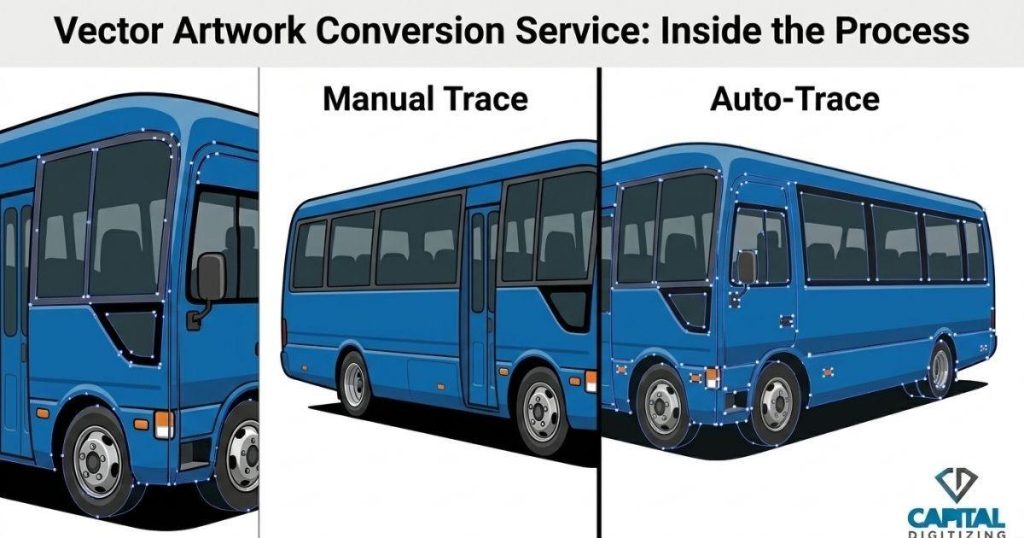
Almost every custom vector art service online uses a manually traced design method.
The redraw is the easy part. The judgement is where files pass or fail at the vendor.
To convert an image to vector, a screen printer needs colours separated onto their own layers. An embroidery digitizer needs shapes simple enough to survive thread. A vinyl plotter needs closed paths with no stray overlaps. A laser or CNC table needs geometry it can follow without ambiguity.
The same logo prepared correctly for one of those is often wrong for another. That is what a vector art service is really selling.
Stage 1: Assessment
Before anything is drawn, the file is examined, and a small number of questions get answered.
- What kind of file is this really? A PDF exported from Illustrator, InDesign, or CorelDRAW already contains vector geometry.
- Where is this going? Screen print, embroidery, vinyl, engraving, sublimation, large-format signage, vehicle wrap. This decides how the design will be created.
- What size will it be reproduced at? A logo destined for a 2-inch chest embroidery gets different treatment from one going on a 40-foot billboard.
- Is there brand documentation? Pantone references, exact fonts, an approved colourway. If it exists, it removes guesswork.
- What must stay exact? Registered marks, a specific typeface, a proportion someone in legal cares about.
Stage 2 to 4: the Rebuild
Stage 2 — Structure.
The image is placed on a locked reference layer. Working layers are created above it, organised the way the destination process will need them, not the way the drawing happens to come together.
Stage 3 — Path construction.
Every shape is drawn with the Pen tool using Bézier curves. The operating principle is fewer, better-placed anchor points. A curve described by four well-positioned points is cleaner, lighter, and more editable than the same curve described by forty.
Stage 4 — Type.
Text is either matched to the correct typeface and then converted to outlines, or redrawn. Outlining matters in the vector designing service because a font that is not embedded will be substituted at the vendor’s end.
Stage 5: Preparing for Your Production Process
The same clean paths get finished differently depending on where they are going.
| Destination | What the file needs |
|---|---|
| Screen printing | Spot colours separated onto individual layers, trapping considered, colours specified as Pantone rather than approximate CMYK |
| Embroidery digitizing | Simplified shapes, gradients resolved into flat areas, thin lines thickened, detail that thread cannot resolve removed or enlarged |
| Vinyl cutting and plotters | Closed paths only, no open ends, no overlapping shapes, weeding practicality considered |
| Laser engraving, CNC | Unambiguous geometry, often DXF output, single-stroke paths where the process requires them |
| Large format and vehicle wrap | Verified at final scale, no raster elements hiding inside the artwork |
| Sublimation and digital print | Colour profile appropriate to the press, full-colour gradients preserved |
Points to note:
Thread has physical thickness. Detail that reads beautifully on screen disappears in stitch.
Embroidered lettering has a practical floor of about 3mm before individual stitches merge and text becomes unreadable.
Satin columns work between roughly 1.5mm and 10mm wide. A converter who understands this thickens hairlines and flags details that will not survive before the file reaches the digitizer.
That handoff is the reason vector conversion and digitizing sit under one roof at Capital Digitizing. It is one of the best embroidery digitizing companies in the USA.
Stage 6 and 7: Quality Control and Delivery
Quality control checklist:
Use the checklist below to check the final output.
- All paths closed where the process requires it
- Anchor point count reviewed and reduced where possible
- No stray points, no zero-width objects, no hidden raster elements
- Fonts outlined
- Colours named and specified correctly, not left as unnamed swatches
- Layers named and ordered logically
- File checked at both the smallest and largest intended reproduction size
- Overlay comparison against the original artwork for proportional accuracy
Delivery.
Files arrive by email or download link in the agreed formats, with the editable source file included so future changes do not require starting over.
Standard turnaround across the market for conversion work is 24 hours or less. Capital Digitizing delivers most orders in 12 to 24 hours. Errors we see repeatedly are common mistakes in online vector art services.
What You Receive, and Which Format Does What
| Format | What it is for |
|---|---|
| AI | The editable Adobe Illustrator source. Keep this. Every future revision starts here |
| EPS | The long-standing print industry exchange format. Most vendors accept it |
| SVG | Web and screen use, scales cleanly in browsers |
| Universal sharing and proofing, opens almost anywhere | |
| DXF | Cutting, CNC and engraving workflows |
| PNG, transparent | Not a vector. Included for previews, presentations and quick placement |
AI, EPS, SVG and PDF are the standard bundle across the market, with DXF and transparent PNG supplied on request. A deeper breakdown sits in our guide to the best file formats for vector art services.
Conclusion
Vector graphic services help separate colours onto the layers your screen printer needs. It determines which detail an embroidery machine will fail to reproduce. Capital Digitizing provides embroidery digitizing & vector art services. Send your brand information and design details.
If you have artwork that needs rebuilding properly, send it over with the details above and get it back production-ready.
FAQs
What happens after I send my artwork for vector conversion?
The file is assessed first to determine whether it already contains vector geometry, which only needs cleanup, or needs a full rebuild.
What file formats will I receive after conversion?
The standard bundle is AI, EPS, SVG, and PDF. DXF for cutting and CNC workflows and transparent PNG for previews are usually available on request.
How long does the vector artwork conversion process take?
Most providers deliver in 24 hours or less, and Capital Digitizing typically returns files in 12 to 24 hours. Simple logos with flat colours convert fastest.
Can low-quality or blurry images be converted into clean vector files?
Yes. A manual redraw does not read pixels, so the designer interprets the shapes and rebuilds them properly.
Do I get revisions if the converted file isn’t accurate?
Yes, revisions within the agreed scope are standard across the industry, and most providers include minor edits at no additional charge. Send specific notes rather than general feedback.
What’s the difference between vector conversion and image tracing?
Image tracing runs an algorithm that follows pixel boundaries automatically. Vector conversion means a designer redraws the artwork by hand with deliberate anchor placement.