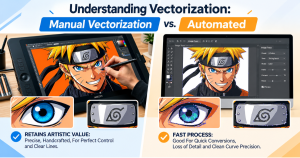
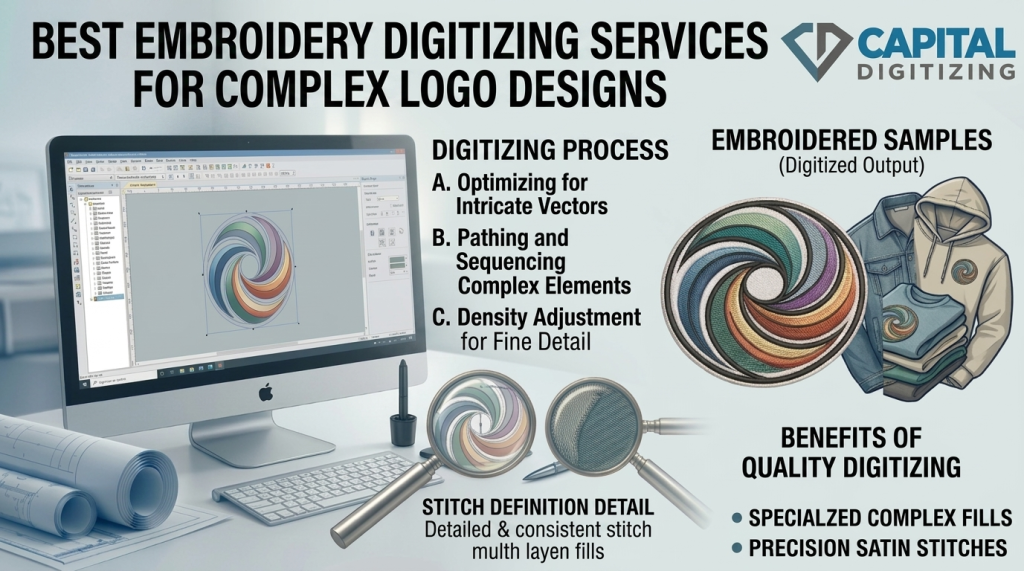
Changing from a smooth digital image to a real, sewn badge can be very complicated. Complex logos demand expert care to prevent production disasters. Here is how a premium embroidery digitizing service transforms intricate artwork into flawless embroidery, protecting your apparel quality and production timeline.
Why Complex Logos Are Hard to Digitize
Complicated digital designs like color fades, small text, and complex shapes can put a lot of stress on commercial embroidery machines. This can lead to thread breaking and designs that look crooked. That’s why it’s important to have logo digitizing services and embroidery digitizing for detailed logos.
- Software Failure: Automatic tools make mistakes with vector lines, leading to tangled stitch paths.
- Production Downtime: Poorly mapped files cause thread bunching, “bird-nesting,” and frequent machine stops.
- Color Sequence Issues: Intricate, multi-color details require strategic color stops and optimized jump-stitch sequencing.
- Legibility Loss: Thin strokes or serif text under 2mm warp under standard satin stitches without specialized compensation.
- Custom Needs: Every unique emblem requires a manual, customized stitch map to run smoothly with the best embroidery digitizing services.
Master professional art-to-stitch preparation by learning how to digitize complex designs like logos and photos for embroidery to ensure a seamless transition from screen to needle.
What Makes Embroidery Digitizing Services “Professional”?
Professional digitizing is a manual art form, not an automated file conversion script. Skilled technicians providing professional embroidery digitizing calculate push-and-pull forces to keep the fabric stable.
- Human Precision: Manual node placement ensures clean pathing that automated tools cannot replicate.
- Machine Harmony: Correct formatting prevents needle deflection and thread breaks on commercial machinery.
- Universal Formats: Files are delivered in stable, machine-readable extensions (DST, PES, EXP, JEF).
- Visual Proofing: Premium providers supply accurate digital before-and-after mockups before production.
- Fair Pricing: Reliable services offer transparent, flat-rate pricing structures for standard placements and dependable logo digitizing services.
Key Factor 1: Stitch Density Calibration
Controlling stitch density is the first step when adjusting complex designs for industrial sewing. It decides how close the rows of thread are to each other. When searching for the best embroidery digitizing services, making sure the density is just right should be your main focus.
- Fabric Rules: Thick materials like denim need to be less dense, while fabrics made for performance require careful planning for the layers underneath.
- Detail Crushing: Tightly grouped design elements need reduced density to prevent needles from cutting holes in fabric.
- Thread Break Risks: Incorrect density settings trigger puckering, frequent thread breaks, and bird-nesting on commercial machines.
- Pre-Calibrated Delivery: Premium professional embroidery digitizing providers customize density settings specifically for your target fabric before delivery.
Key Factor 2: Digitizing Software Quality
Software limitations dictate the quality of your finished embroidery, as low-tier auto-converters flatten gradients and skip essential underlays. Choosing dedicated logo digitizing services eliminates these technical limitations.
- Industrial Tools: Master digitizers rely on elite industry-standard suites like Wilcom, Hatch, or Tajima DG/ML.
- Node Control: High-end programs allow for precise, manual node-by-node adjustments along curves and sharp points.
- Operator Skill: Software is merely a tool; the technician’s hands-on experience determines final production speed through professional embroidery digitizing.
- Flawless Gradients: Advanced design engines ensure intricate vector details and complex color transitions translate accurately.
Key Factor 3: Thread Type Selection
Standard digitizing services often ignore how different thread types interact with code. A file built without a specific thread in mind causes fraying or loop pull-outs, making specialized embroidery digitizing for detailed logos essential.
- Rayon Thread: Features a high-luster sheen that is perfect for elegant corporate apparel and detailed logos.
- Polyester Thread: Offers extreme durability and bleach resistance, making it the standard for workwear and uniforms.
- Metallic Thread: Gives an ultra-premium look but features a delicate core requiring wider stitch spacing and lower tension.
- Built-in Guidance: High-quality logo digitizing services build specific thread type considerations right into the structural pathing.
Key Factor 4: Fabric Type Compatibility
A file digitized for a flat cotton tote bag will completely fail on a stretchy polo. Different fabric types react uniquely to the pulling force of an industrial needle.
- Stretchy Knits: Materials like jersey require heavy underlay protection and lighter top density to stop fabric warping.
- Deep-Pile Fabrics: Fleece and towels require an underlying run-stitch ceiling to keep fine details from sinking into loops.
- Curved Surfaces: Framing structured caps requires a specialized center-out radial stitch path to prevent rippling.
- Tailored Specialties: Providers must offer distinct setup paths for jackets, caps, towels, and flat goods to ensure consistency.
Key Factor 5: Embroidery Machine Optimization
Commercial machinery interprets vectors into raw coordinates. Because every machine line operates with a different mechanical tension, formatting dictates production speed for embroidery digitizing for detailed logos.
- Native Coding: Files must speak the exact language of your Tajima, Brother, Barudan, or Melco setup.
- Command Preservation: Generic tools corrupt essential trim codes, causing messy jump stitches that operators must hand-trim.
- Zero Conversion Fees: Professional services provide your required native machine format with zero extra charges.
- Workflow Protection: Machine optimization is built directly into the file setup to prevent skipped stitches on the floor using the best embroidery digitizing services.
DIY Auto-Digitizing vs. Professional Logo Digitizing: Real Comparison
Many apparel startups fall into the trap of using free online auto-converters to save on setup costs. However, a single ruined batch of jackets or polo shirts quickly costs far more than a professional setup fee.
| Technical Factor | Auto-Digitizing (Free Tools) | Capital Digitizing (Professional) |
| Fine Logo Detail | Lost, distorted, or heavily warped | Preserved perfectly via manual node editing |
| Stitch Density Control | Generic, single-layer mapping | Calibrated precisely per fabric & logo type |
| Thread Break Risk | Extremely high due to overlapping nodes | Near-zero via optimized underlay sequences |
| Machine Compatibility | Limited, unstable format choices | All major commercial formats provided |
| Turnaround Time | Instantaneous (Unusable production quality) | 12–24 Hours (Production-ready and tested) |
| Base Pricing | Free to $5 | From $10 (Left Chest / Cap formats) |
The Verdict: Automated apps work fine for basic geometric blocks, but they fail when confronted with complex branding. Boost efficiency by investing in premium logo embroidery digitizing for clean, high-performance stitch files. Choosing the best embroidery digitizing services protects your machinery and your bottom line.
How Capital Digitizing Handles Complex Logo Designs
We have engineered our production pipeline to take the headache out of commercial embroidery setups. We ensure your detailed business emblems stitch out beautifully on the first try with embroidery digitizing for detailed logos.
- Step 1 – Upload: Send your artwork (JPG, PNG, PDF, or Vector) directly through our secure client portal.
- Step 2 – Map: A veteran digitizer manually plots out your design path, density, underlay protection, and color stops.
- Step 3 – Proof: We send a detailed before-and-after digital mockup, offering free minor revisions until you are satisfied.
- Step 4 – Deliver: Get your production-ready file delivered in 12–24 hours in your machine’s native format.
Affordable Scale: Enjoy transparent pricing starting at $10 for left-chest/caps and $25 for large jacket backs with professional embroidery digitizing. Partner with an industry leader like Capital Digitizing for 24/7 access to expert embroidery designers.
Conclusion
Avoid complicating matters and affecting the performance of your embroidery machine. Through the expertise of professionals, you will reduce costs, prevent problems with the machine, and ensure that your elaborate logo is produced in a very professional manner in any kind of fabric.
Capital Digitizing expertly transforms your most intricate logos into flawless, production-ready stitch maps for any fabric.
1. How do professionals digitize complex logo designs?
Professionals manually map paths, set node-by-node coordinates, and calibrate stitch density for specific industrial fabrics.
2. Why is digitizing important for detailed embroidery logos?
It translates complex vector art into machine-readable code, preventing thread breaks, puckering, and alignment ruining.
3. How much does embroidery digitizing for logos cost?
Professional manual services typically start at $10 for caps and scale up for complex jacket backs.
4. What file formats are used in embroidery digitizing?
Common machine-ready production formats include DST, PES, EXP, JEF, and native software source files.
5. What mistakes should be avoided in logo digitizing?
Avoid automated conversion software, ignoring fabric stretch, overlapping nodes, and incorrect underlay stitch planning.