Custom embroidered patches give an excellent chance to personalize your items, promote your brands, or unite your teams. But how long the custom patch can last depends significantly on its usage and maintenance. This helpful guide makes sure your custom patch embroidery stays bright and safely stuck for many years.
Why Backing Type Matters for Long-Term Patch Durability
The selection of the backing determines the lifespan of your custom patch design. Equally treating all types of backing materials is a prevalent error that will cause patches to fade or peel off after just a few weeks if there is an incompatible relationship between the two materials.
It depends on your intended use of the patch and its care as to which attachment option is better for you:
- Iron-On Backing: A quick and easy process that attaches to everyday wear.
- Sew-On Patch: Best in terms of durability and endurance.
- Velcro Backing: Suitable for uniforms that require frequent changes.
At Capital Digitizing, we offer all three options tailored to your specific durability needs. Knowing how to wash embroidered patches safely will also extend the life of these backing types. Explore and order high-quality custom embroidered patches directly from our service page.
Quick Comparison: Iron-On vs Sew-On vs Velcro Backing
| Backing Type | Application Method | Best Fabric | Durability | Removable? |
| Iron-On Backing | Heat Press/home iron | Cotton, denim, canvas | Moderate | No |
| Sew-On Patches | Machine or hand stitch | All Fabric Types | Highest | No |
| Velcro Backing | Hook-and-loop attachment | Nylon, canvas, uniforms | High | Yes |
How to Apply Iron-On Backing Patches Correctly
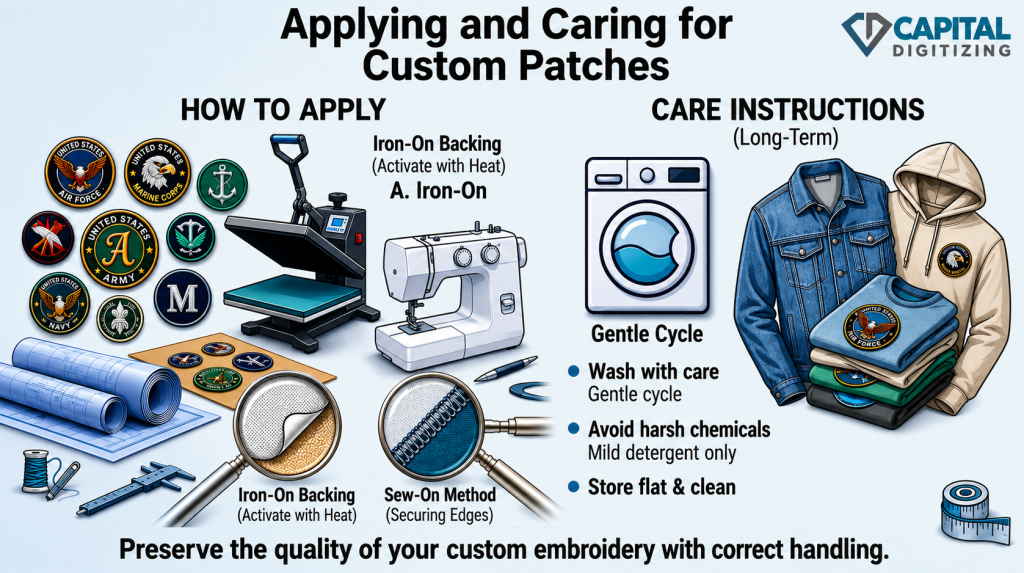
To successfully attach a custom patch using an Iron-On Backing, heat management is everything. You must completely avoid steam, as moisture breaks down the adhesive bond before it can cure. When you order your custom patch embroidery, follow these steps for the best results.
Grip the item using these simple guidelines:
- Prep: Heat your domestic iron or heat press machine between 3300–320°F (148–160°C) without steam.
- Placement: To prevent burns, position the custom patch design with its face up and place parchment paper or a thin piece of fabric over it.
- Press: Apply static and firm pressure directly onto the patch for 25-30 seconds.
- Seal: Turn the fabric inside out and apply heat for 15 seconds from behind.
Note: The technique will work efficiently on thick cotton fabric, but is ineffective on fabrics that cannot withstand high temperatures, such as nylon and leather. For longevity, consider stitching it.
How to Apply Sew-On Patches for Maximum Hold
For items that get used a lot and are worn out, Sew-On Patches are the best choice. This traditional method bypasses heat limitations entirely and works across all structural Fabric Types.
Remember these sewing tips for your custom patch:
- Thread Choice: Use a strong polyester or nylon thread that matches the outer side of your patch as much as possible.
- Stitch Placement: Sew an immaculate straight stitch on the inner side of your merrowed border at about 2 to 3mm from the outer side.
- Finishing: Ensure you lock down both ends of your thread with a solid backstitch.
Capital Digitizing designs its custom patch embroidery merrow borders specifically with a uniform thickness to ensure easy needle penetration, whether you stitch by hand or use an industrial machine. It is perfect for heavy workwear, bags, and leather. Check out our top 10 custom embroidered patch ideas for backpacks and jackets for creative style inspiration.
How to Use Velcro Backing on Custom Patches
A Velcro Backing provides unparalleled flexibility for modern tactical and organizational gear. This style utilizes a reliable two-part hook-and-loop system, keeping your custom patch design interchangeable.
Maximize the benefits of your removable patches:
- The Setup: The rough “hook” side comes pre-attached directly to the back of the embroidered emblem.
- The Application: Sew the soft “loop” side panel onto your garment or tactical bag permanently.
- The Benefit: Swap out designs instantly to match changing roles, ranks, or team events.
This configuration is ideal for military uniforms, corporate flight jackets, and modular gear bags where team designations shift. Our custom patch factory supplies both sides of the premium hook-and-loop system. Remember, even with Velcro, you must know how to wash embroidered patches safely to keep the hooks clean.
Fabric Types That Work Best With Custom Patches
The base textile behaves differently depending on the custom patch application method used. Understanding your material protects against premature lifting and fabric damage.
Match your backing to these specific Fabric Types:
- Excellent (Cotton, Denim, Canvas): Very robust, tightly woven fabrics resistant to ironing, heat, and heavy embroidery.
- Moderate (Polyester Blends): Sewing on this material is advised because heat can melt synthetics.
- Avoid for Heat (Nylon, Leather, Rayon): These materials can easily be distorted by exposure to high temperatures.
Our team at Capital Digitizing is happy to advise you on the absolute best backing solution for your specific textile choice during the initial design process.
How to Wash Embroidered Patches Safely
Washing the patches incorrectly is the main reason they don’t last long. To wash embroidered patches safely, use a low temperature to keep the backing strong and the shiny thread looking nice.
| Method | Setting | Temperature | Notes |
| Machine Wash | Gentle / Delicates cycle | Cold (30°C maximum) | Turn inside out; use a mesh laundry bag |
| Hand Wash | Gentle soak & rinse | Cool water | Use mild detergents only; do not scrub |
| Drying | Air dry flat | No heat | Never use a tumble dryer |
| Post-Wash Ironing | Low heat with a cloth cover | — | Never iron directly onto the raw embroidery. |
Using targeted how to wash embroidered patches safely techniques protects your investment over time:
- Always turn the clothes inside out before washing them to protect the fabric threads from the rubbing process.
- Avoid using fabric conditioners or bleach since they chemically break down the fibers of the threads and remove color pigments.
- Don’t use a tumble dryer when dealing with a sew-on patch because the heat will melt the adhesive on the patch.
Long-Term Storage & Maintenance Tips
When buying in bulk, the proper means of storage would assist in ensuring long-lasting custom patch design projects. The environmental factors, like moisture and light, are your biggest opponents in this case.
Maintain your collection with these storage rules:
- Storage: Place loose patches flat in acid-free, zipped bags to protect against dust and moisture.
- Light Control: Keep your patch collection away from direct sunlight to ensure that UV rays do not wash out thread colors.
- Inspections: Check your ironed-on apparel annually; a quick 10-second re-press with an iron easily fixes minor edge lifting.
- Reorders: Choose an established custom patch factory that keeps your digitized files secure for instant duplicates.
For bulk reorders, Capital Digitizing, as a custom patch factory, maintains your original design file, easy reorder, and consistent quality.
Where to Order a Custom Patch Design That Lasts
When durability matters, you need a professional, reliable custom patch factory. Visit Capital Digitizing for professional embroidery solutions combining top-tier support with state-of-the-art manufacturing.
Why brands trust our custom patch embroidery:
- We provide digital proofs before manufacturing to ensure zero surprise results.
- We have many different styles, like Chenille, Leather, PVC, Woven, and regular embroidery.
- Every order features tight, commercial-grade thread counts and robust edge bindings.
Conclusion
By using the appropriate backing for your patch on the type of material you are using and taking care of them during laundering, your patches will be strong and beautiful. Collaborate with a reliable manufacturer such as Capital Digitizing to get high-quality work that will last forever.
Choose Capital Digitizing for precision-engineered, commercial-grade custom patches that represent your brand flawlessly.
How do you apply a custom embroidered patch properly?
Sew it on for permanent hold, or iron at 300–320°F without steam on heat-safe fabrics.
How can I make my custom embroidered patches last longer?
Wash garments inside-out on cold, air dry completely, and add border stitching to iron-on styles.
Which backing type is best for long-term durability?
Sew-on backing is the most durable method because it avoids adhesive failure and heat limitations.
What is the safest way to clean clothes with embroidered patches?
Wash inside-out on a gentle, cold cycle, then air dry flat. Never use tumble heat.
Can embroidered patches be reused or removed easily?
Velcro backings allow instant swapping. Sew-on patches can be removed carefully by cutting the attachment threads.