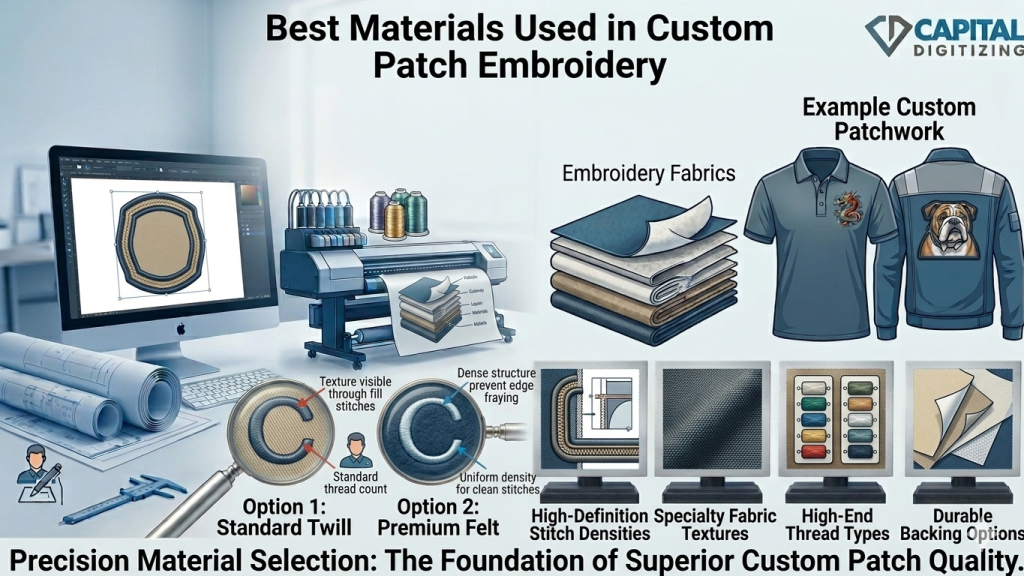
Selecting the right materials can assist ensure that your patch stays intact for many years rather than wearing off after the first washing. Each component used in making patch embroidery is of extreme importance. When creating a custom patch for your sports team uniform, information on materials used in custom patch embroidery will definitely prove useful. At Capital Digitizing, we focus on making custom patches that are very well-made. We use strong fabrics that work well for today’s clothing.
Why Material Choice Defines Patch Quality
The look and quality of a custom embroidered patch depend a lot on the type of material used. Low-quality materials can cause stitches to come loose, colors to fade, and things to stick poorly.
Good embroidered patch materials and custom patch making always pay attention to:
- A smooth stitch that doesn’t have any spaces.
- Custom patch manufacturing is built to last for everyday use.
- Resistance to fraying and breaking threads.
In simple terms, using better materials means the patches will last longer and have clearer details.
Base Fabrics: Twill vs. Felt vs. Polyester
The bottom layer of any patch is its fabric. This is where the needle goes in first.
- Twill: The “Gold Standard” material. Characterized by its diagonal weave, which makes it extremely durable while enabling stitching without deformation. Suitable for uniforms and hats in custom patch manufacturing.
- Felt: Commonly employed in vintage or “letterman” jackets. It provides a soft texture but is not recommended for intricate designs due to its loosely-knitted nature compared to high-quality fabrics used in custom patch embroidery, like twill.
- Polyester: Highly valued for its water resistance and colorfastness; polyester is best for outdoor clothing and athletic wear.
Material selection works best when combined with custom embroidery digitizing, ensuring clean stitching and accurate design results.
Twill fabric can be considered a very good choice for a custom embroidered patch.
Polyester Thread: The Engine Behind Every Design
Some people like Rayon because it is very shiny, but in 2026, most choose polyester thread for making custom patch embroidery. Using the right embroidered patch materials ensures it stays intact despite being bleached. This is a staple in custom patch manufacturing as it has high durability and maintains its color for extended periods of time.
- Durability: The high-quality fabrics used in custom patch embroidery can endure the rapid pulling process of the embroidery machines without breaking down.
- Color Matching: The Pantone color chart is used for precise matching of your embroidered patch with the colors of your company or organization.
Embroidery Backing: Iron-On, Sew-On & Velcro
Backing decides how a custom patch embroidery sticks to fabric.
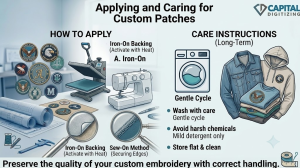
- Iron-On Backing
The special glue for ironing on embroidered patch materials will stick once you heat it. Patches can be easily placed onto any piece of clothing and bags with ease during custom patch manufacturing. This technique works great for daily wear and items that require infrequent washing.
- Sew-On Backing
As implied by its name, the sew-on backing requires sewing high-quality fabrics used in custom patch embroidery directly into the garment or accessory. It is the most durable type of backing available for a custom embroidered patch. This choice offers lasting strength and dependability.
- Velcro Backing
Velcro backing has a hook-and-loop system that makes it easy to stick and take off custom patch embroidery. It is often used in gear for soldiers, military clothes, and team outfits. This choice of embroidered patch materials is great for designs that can be used again and swapped out easily.
Each choice is good for different uses based on the type of clothing and how strong it needs to be.
Patch Borders: Merrow Edge vs. Laser Cut
The border prevents the high-quality fabrics used in custom patch embroidery from fraying and gives it a finished look.
- Merrow Edge: A classic, thick, wrapped border for a custom embroidered patch. It’s perfect for standard shapes like circles, squares, and shields.
- Laser Cut (Hot-Cut): This uses heat to seal the edges of custom patch embroidery in complex, custom shapes. If your design has intricate “out-and-in” edges, laser-cut is the only way to go.
Looking for creative inspiration? Explore our guide on custom embroidered patch ideas for backpacks and jackets.
Quick Comparison: Materials at a Glance
| Material/Component | Best Option | Why It Matters |
| Base Fabric | Twill | Superior durability and stitch support |
| Thread | Polyester | Colorfast and abrasion-resistant |
| Backing | Sew-On | Maximum permanence for uniforms |
| Border | Laser Cut | Precision for complex, custom shapes |
Conclusion
Materials of good quality are considered in the design and production of an embroidered patch. The composition and durability of an embroidered patch can be affected by anything from polyester threads to twill fabrics. It becomes quite simple to pick the best for your purpose once you have knowledge about the materials available to make embroidered patches. Your creative ideas will depend upon your choice of materials in making fashion patches or logos.
Capital Digitizing crafts durable, high-precision custom patches using premium materials for long-lasting, professional brand representation.
FAQs
What is the best material for embroidery patches?
Twill fabric with polyester thread offers the best durability, detail, and professional finish.
What material is best for putting patches on?
Sew-on backing is best for strength; iron-on works for quick, light-use applications.
What does PVC mean for patches?
PVC patches use flexible plastic instead of thread, offering waterproof, durable, and bold designs.
What supplies do I need to make embroidery patches?
You need base fabric, embroidery thread, stabilizer, backing, needle, and an embroidery machine.
Can I use 100% cotton for embroidery?
Yes, but cotton is less durable than twill or polyester for long-lasting patches.